
French Hotel Market: Record Investment and a Sought-After French Riviera
An analysis of hotel investment, operating performance and value drivers in France and on the French Riviera, based on RYDGE Hospitality’s 2026 study.
RYDGE Hospitality’s *French Hotel Industry in 2026*, 49th edition, points to a lasting recovery in hotel investment in France. Behind the record transaction volume, however, the market is becoming more selective: rare, well-operated assets with a strong connection to their destination are attracting the greatest demand. The French Riviera is one of the clearest examples.
Record investment in a more selective market
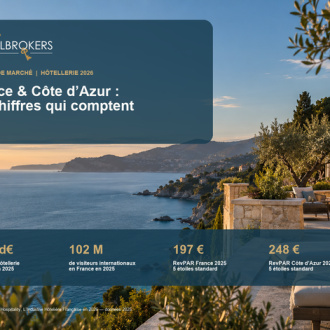
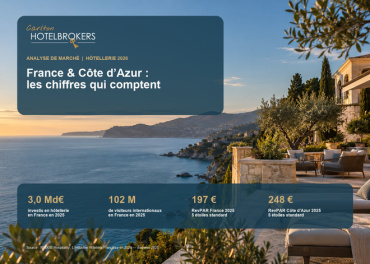
€3 billion was invested in the French hotel sector in 2025. According to RYDGE Hospitality, this was the highest level ever recorded, approximately 44% above the ten-year average. Hotels accounted for 18% of French commercial real estate investment volumes.
Momentum continued into 2026: hotel transaction volume reached close to €1.3 billion in the first half of the year, up approximately 40% year on year. This return of capital is primarily benefiting prime assets, leisure hotels and destinations that combine international visibility, scarcity and strong operating quality.
The record figure does not mean that every hotel is easy to sell. Buyers are closely reviewing location, positioning, CAPEX requirements, operating structure and earnings visibility. In a **hotel freehold and business sale**, value must remain consistent with the real estate, the operating business, any rent payable and the required investment programme.
Strong tourism demand, but uneven operating performance
France welcomed 102 million international visitors in 2025, two million more than in 2024. This supports hotel demand, but performance is not improving evenly across every segment.
Three- and four-star hotels, as well as lower categories, are broadly experiencing a normalisation after the Olympic Games: average rates and RevPAR are stable or slightly lower depending on the segment. Upscale and luxury hotels are the exception. Across France, RevPAR for standard five-star hotels reached €197.1 in 2025, up 4.8%. For upper five-star hotels, it reached €421.7, up 17.7%.
This split matters in a transaction context. Value is no longer driven by occupancy alone. It also depends on the ability to protect average rates, sustain margins and deliver a differentiated guest experience. RYDGE Hospitality also identifies more than 14,500 hotel rooms in development across France by 2030, making a clear positioning and an appropriate refurbishment strategy even more important.
French Riviera: upscale performance and scarce assets
The French Riviera occupies a distinctive position within the French hotel market. International demand, leisure appeal, limited land supply and exceptional locations support the depth of the upscale market.
In RYDGE Hospitality’s panel, standard five-star hotels in Provence-Alpes-Côte d’Azur achieved a 2025 RevPAR of €248.1, up 20.8%, compared with a French average of €197.1 for the same segment. Their average daily rate reached €376.5, up 15.9%. Upper five-star hotels achieved RevPAR of €556.5, up 8.2%, and an average daily rate of €923.8.
These figures are not directly comparable with every property in the region. They nevertheless demonstrate the ability of the best local assets to attract high-spending guests when the product, service and destination are fully aligned.
Transactions reinforce investor interest
The report highlights several transactions that illustrate this appeal: the acquisition of Cap Estel in Èze for €200 million, the transaction involving Hôtel La Pérouse in Nice for €60 million, and acquisitions in Cannes and Antibes. Such transactions should not be applied mechanically as benchmarks for other hotels; they do, however, demonstrate investor interest in rare, well-located properties supported by a credible operating strategy.
Brand strength, food and beverage, wellness, guest experience and operational organisation are increasingly part of hotel value. Food and beverage now represents more than 25% of turnover in French three- to five-star hotels and can exceed 50% in some properties, according to RYDGE Hospitality. When profitable and coherent with the asset, it can support average rates, strengthen appeal and contribute to value.
For owners and buyers alike, a hotel must therefore be considered as an operating business, a real estate asset and a long-term holding. That is the purpose of a **hotel acquisition search mandate**: identifying properties whose location, operating potential and value trajectory truly match an investment strategy.
Sources and methodology
Primary source: RYDGE Hospitality, *The French Hotel Industry in 2026 – 49th edition*, September 2026. Hotel supply and tourism data cited in the study are drawn in particular from INSEE. The RevPAR figures in this article relate to the categories and panels specified by RYDGE Hospitality; they are not a valuation of any individual hotel.
This article draws on RYDGE Hospitality data for the 2025 financial year and, for investment activity, the first half of 2026. The transaction and asset-value perspective is Carlton Hotelbrokers’ own analysis.